
Theo Peters · 24 October 2026
Leveraging Semantic Linking to Enhance Retrieval Efficiency in Enterprise Note Repositories
Enterprise note repositories have grown into vast collections where employees store project details, meeting outcomes, and technical specifications across distributed teams. Semantic linking connects these entries through conceptual relationships rather than surface-level keywords, allowing retrieval systems to surface related content even when terminology varies between departments or regions. This approach draws on natural language processing techniques that map entities, relationships, and contexts into structured graphs, which then guide search algorithms toward higher precision results.
Core Principles of Semantic Linking
Researchers at institutions studying information systems have documented how semantic models build on ontologies that define classes such as tasks, resources, and outcomes, along with properties that link them. When a note about quarterly budget planning references resource allocation, the system can automatically associate it with earlier entries on vendor contracts or staffing projections. Data from large-scale deployments shows retrieval times decrease as these connections accumulate, because queries no longer depend solely on exact phrase matches. Observers note that organizations adopting graph-based indexes report fewer missed documents during compliance audits, since contextual trails remain intact even after staff changes or terminology updates.
Technical Implementation Pathways
Implementation typically begins with ingestion pipelines that extract entities and infer links using pre-trained language models fine-tuned on domain-specific corpora. These pipelines operate alongside existing note platforms, layering semantic metadata without disrupting user workflows. Integration often involves mapping internal taxonomies to established standards such as those maintained by international bodies focused on data interoperability. One study from a Canadian research consortium revealed that enterprises combining rule-based validation with machine learning classifiers achieved consistent link accuracy above 85 percent within the first six months of rollout. System architects further refine these connections by incorporating user interaction signals, such as frequent co-access patterns, which strengthen edge weights in the underlying graph.
Impact on Search Performance Metrics
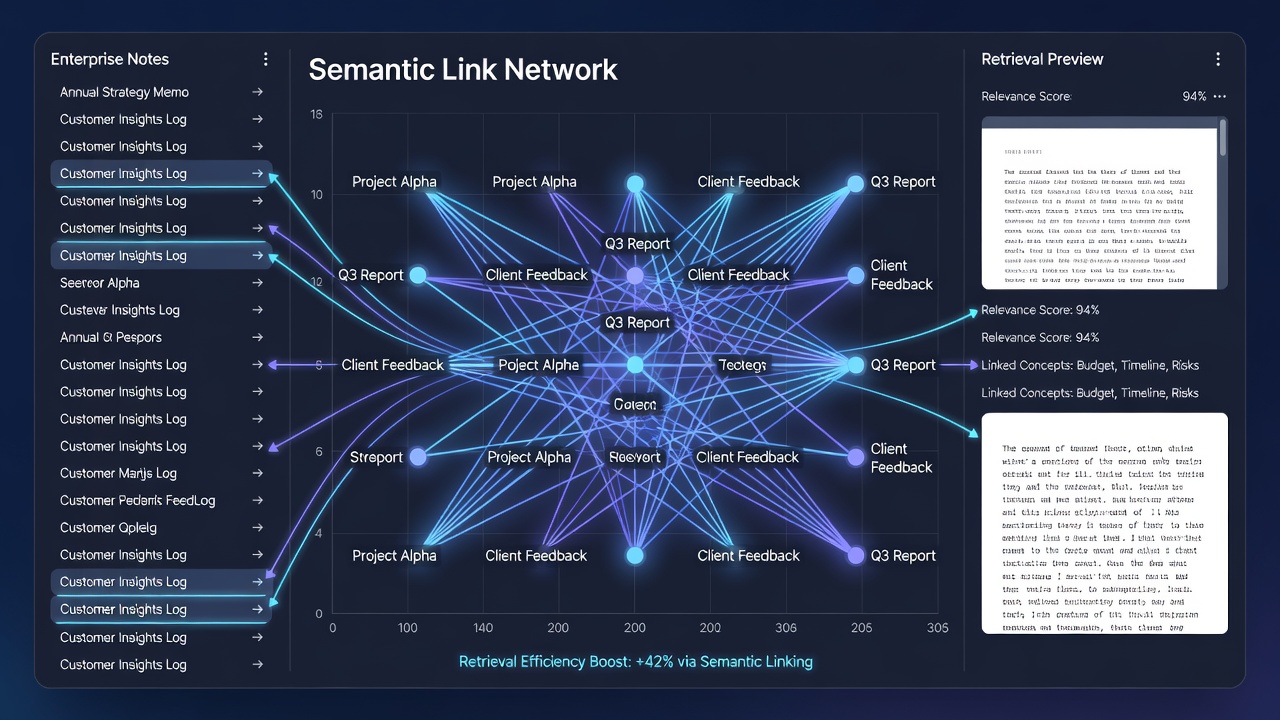
Performance evaluations conducted across multiple sectors indicate measurable gains once semantic layers stabilize. Recall rates for complex queries rise because related notes surface through indirect paths, for instance linking a regulatory update in one department to implementation notes stored elsewhere. Precision improves simultaneously as irrelevant keyword matches receive lower ranking scores. Figures from industry reports compiled in late 2025 demonstrate average reductions in time-to-find of 30 to 40 percent among teams managing repositories exceeding 500,000 entries. These gains compound when repositories feed downstream applications such as automated reporting tools or knowledge assistants that traverse the same graph structures.
Integration with Existing Enterprise Systems
Many organizations maintain hybrid environments where legacy databases coexist with modern note platforms. Semantic linking bridges these silos by exposing unified query interfaces that translate natural language requests into graph traversals. Middleware components handle synchronization so that updates to source notes propagate link recalculations within defined time windows. Australian government guidelines on digital record management emphasize the value of maintaining provenance metadata during such integrations, which preserves audit trails while enabling semantic enrichment. Teams that schedule periodic ontology reviews maintain alignment as business processes evolve, preventing drift between modeled relationships and actual usage patterns.
Developments Anticipated by October 2026
Upcoming releases of major note platforms scheduled for October 2026 include native support for federated semantic graphs that span multiple cloud tenants. These features will allow retrieval across partner organizations while enforcing access controls defined at the relationship level. Academic groups continue publishing benchmarks that compare embedding models on enterprise-scale corpora, with results expected to guide selection criteria for new deployments. Regulatory frameworks in the European Union continue to shape requirements around explainability of automated links, prompting vendors to expose reasoning paths within search interfaces.
Conclusion
Semantic linking transforms enterprise note repositories from flat collections into interconnected knowledge networks that support faster and more accurate retrieval. Organizations achieve these outcomes through systematic application of entity extraction, graph construction, and ongoing refinement based on usage data. As platforms incorporate federated capabilities by October 2026, the same principles extend to collaborative environments spanning multiple entities. Continued measurement against established performance indicators ensures that efficiency improvements remain verifiable and aligned with operational needs.